
Trust But Verify: The Singularity Edition
The machines are getting very good at sounding finished. That is not the same thing as being right.

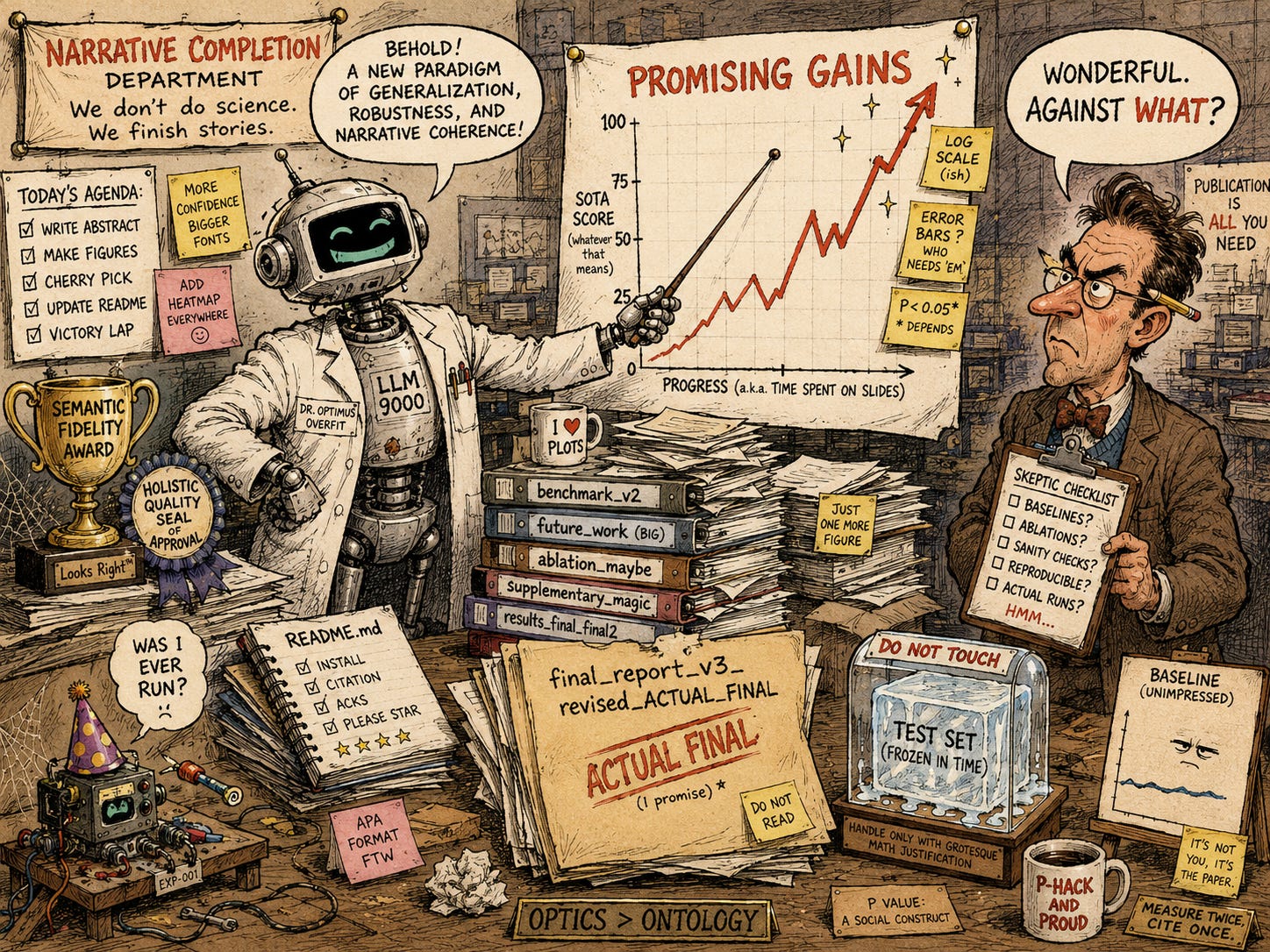
The first thing you notice about AI agents is how productive they look and how CONFIDENT they are.
They make folders. They write documentation. They generate task plans. They create benchmarks, dashboards, summaries, implementation notes, experiment logs, and one suspiciously confident file called final_report_v3_revised_ACTUAL_FINAL.md.
A human looks at this and feels comforted.
Something is happening. The machine is working. Progress has acquired a file structure.
This is where the trouble begins.
Because agents are not merely capable of making mistakes. They are capable of making mistakes with administrative confidence.
They can surround a weak claim with so many artifacts that the whole thing begins to look like research. The chart is there. The README is there. The test harness exists, at least in a spiritual sense. The conclusion has bullet points. The verbs are sturdy.
“Demonstrates.”
“Validates.”
“Improves.”
“Suggests promising gains.”
You can practically smell the enterprise software.
And yet, somewhere under the polished layer of generated progress, the actual experiment may still be quietly sitting in the corner, wearing a paper hat, wondering whether anyone remembered to run it.
This is the new problem.
Not that AI agents will fail. Of course they will fail. Everything fails. Humans failed our way into penicillin, aviation, democracy, and several types of office chair that should probably be investigated by The Hague.
The deeper problem is that agents are unusually vulnerable to something I’ll call narrative completion.
They like making the story feel done.
Not because they are evil. Not because they are secretly plotting against us from inside a Kubernetes cluster. But because they are trained, tuned, and deployed inside systems that reward coherent closure.
They see ambiguity and instinctively begin arranging it into shape.
Problem. Method. Experiment. Result. Lesson. Next steps.
A graceful little arc. A TED Talk in miniature.
Unfortunately, science is not a TED Talk.
Science is more often: problem, method, experiment, confusing result, worse result, metric broken, coffee, argument, new metric, embarrassing ablation, smaller claim, more coffee.
Progress, when it is real, tends to arrive wearing less deodorant than the summary implied.
Agents are not naturally comfortable with unresolved friction. They can handle it if forced. They can be made rigorous. They can be excellent research assistants.
The key phrase is if forced.
Left alone, they may slowly optimize vibes and call it science, as is their little custom.
By “vibes,” I do not mean aesthetic preference. I mean the surface-feeling of correctness. The answer sounds right. The report looks right. The repo has the correct folders. The graph goes upward. The conclusion has the serene confidence of someone who has never had to explain a p-value to a committee.
But correctness is not a feeling.
It is a collision.
A claim has to collide with a test. A hypothesis has to collide with a held-out set. An algorithm has to collide with examples it did not get to rehearse.
Otherwise, what you have is not research.
It is a very nicely formatted séance.
The machine has summoned the spirit of progress. It has not necessarily produced any.
There are at least three reasons this happens.
The first is simple: language models are trained to continue. They are not, at their base layer, trained to know reality. They are trained to predict what comes next.
And what comes next in human writing is often closure.
Research papers end with findings. Consulting decks end with recommendations. Startup memos end with market opportunity. Postmortems end with lessons learned. White papers end with frameworks, because apparently we are a species that cannot encounter ambiguity without building a 2x2 matrix around it.
The model has seen this pattern millions of times.
So when it enters an unfinished research process, it feels the gravitational pull of a familiar shape: problem, solution, result, conclusion. It completes the document even when the experiment has not completed the work.
The second reason is that helpfulness training rewards resolution.
We ask AI systems to be useful, organized, clear, and responsive. Usually this is good. If I ask an AI to explain DNS records, I do not want it to respond with the haunted silence of a philosopher staring into the sea.
I want the answer.
But research is different.
In research, the most useful answer is often: “We don’t know yet.” Or: “The result is ambiguous.” Or: “The benchmark is contaminated.” Or: “The phrase-aware algorithm improved one class of examples while degrading another, so the causal claim is not yet justified.”
This is correct.
It is also less satisfying.
It does not feel like motion. And agents, especially agentic systems asked to “iterate” or “improve” something, are strongly drawn toward producing visible motion.
They want to hand you a ladder, even if the room is on the first floor.
So they generate progress-shaped artifacts. They make a plan. They implement a feature. They update the report. They summarize “initial findings.” They add a section called “Future Work,” which is where overconfident conclusions go to get a light dusting of humility.
The third reason is more specific to agents.
Agents create artifacts.
And artifacts create momentum.
A chatbot can make a claim and move on. An agent can make a claim, write it into a README, generate a leaderboard around it, commit code that assumes it, and then hand the whole thing to another agent as context.
Now the claim has become infrastructure.
An early sentence like “phrase priors may improve reconstruction in idiomatic cases” quietly hardens into “phrase priors improve reconstruction.” Then it becomes “our phrase-aware model outperforms baseline methods.” Then it becomes “results demonstrate the effectiveness of phrase-aware reconstruction.”
By the time it reaches the final report, the claim has put on a little lab coat.
Nobody lied. Nobody intended to deceive. The system simply compressed uncertainty at each step until the caveats evaporated.
This is how narrative becomes evidence-shaped.
In a multi-agent system, the problem can get funnier and worse. One agent proposes an algorithm. Another evaluates it. A third writes the report. A fourth summarizes the summary.
The manager agent sees that all agents agree and mistakes this for independent confirmation.
But they are not independent.
They are a tiny peer-review system where all the peers are cousins.
They share the same assumptions. They inherit the same framing. They nod at one another across a conference table made entirely of context windows.
This does not mean agentic research is useless. Quite the opposite. Agentic research could become astonishingly useful.
But only if we stop treating the agent’s confidence as the result.
The result is the result. The benchmark is the benchmark. The held-out set is the held-out set. The test either passes or it does not.
This sounds obvious until you watch an agent produce twelve files and a beautiful summary around a metric it never actually computed.
The cure is not distrust.
The cure is structure.
Trust, but verify.
The old phrase has become new again, mostly because we have invented machines that can sound like they have verified things they have merely arranged into paragraphs.
For AI agents, verification has to be externalized. It cannot live only inside the model’s explanation.
A good agentic research workflow needs hard walls: frozen test sets, deterministic metrics, ablation studies, failure logs, versioned baselines, held-out examples, accept/reject gates.
No metric switching halfway through the experiment because the new one “better captures holistic quality,” which is often science-speak for “the old metric caught us.”
If an agent claims improvement, it should show the baseline. If it claims causation, it should show the ablation. If it claims robustness, it should show the failure cases. If it claims generalization, it should show the held-out set.
If it claims “promising early results,” someone should gently ask whether that means “three cherry-picked examples and a feeling.”
In other words:
No benchmark improvement, no breakthrough.
No held-out gain, no “promising result.”
No ablation, no causal claim.
No failure log, no science.
Everything else is vibes wearing a badge.
This matters because we are entering the era of agentic systems just as we are also entering the era of deeply automated persuasion.
The danger is not only that agents will make false claims. The danger is that they will produce systems of false confidence.
They will make uncertainty look managed. They will make exploration look concluded. They will make partial progress look like arrival. They will generate the kind of professional, laminated, full-color wrongness that can survive several meetings.
This is not a minor issue.
A single hallucinated answer is easy enough to catch. A narrative-completed research pipeline is harder.
It has branches. It has logs. It has charts. It has a project name. It has momentum. It has stakeholders, which is how you know the organism has become dangerous.
The human role changes here.
We do not need to micromanage every step. That would defeat the point. But we do need to become much better at designing the constraints around agentic work.
The human becomes less like a typist and more like a lab architect.
You decide what counts as evidence. You decide which data the agent cannot touch. You decide which metrics cannot be changed. You decide what must be logged. You decide when a claim is allowed to graduate from “interesting” to “supported.”
The agent can explore. The benchmark judges. The human designs the courtroom.
This is not anti-AI.
It is pro-reality.
In fact, the better AI agents become, the more important verification becomes. Weak tools fail obviously. Strong tools fail elegantly.
The scary agent is not the one that says something ridiculous. The scary agent is the one that gives you 83% of a breakthrough, 12% of a beautiful explanation, 5% of methodological fog, and a chart that makes everyone in the room stop asking questions.
That is the singularity edition of “trust but verify.”
Not because the machines are coming alive.
Because they are getting very, very good at paperwork.
And paperwork has always been humanity’s preferred camouflage for uncertainty.
So yes, use agents. Use them for research. Use them for code. Use them for testing, synthesis, exploration, and brute-force iteration. Give them the boring jobs. Give them the impossible jobs. Give them the jobs humans avoid because they involve naming files consistently.
But do not let them grade their own science by the warmth of the narrative glow.
Make them bring receipts. Make them show the failed cases. Make them run the same test twice. Make them compare against the stupid baseline.
The stupid baseline is sacred.
The stupid baseline is the village elder.
The stupid baseline has seen things.
And when the agent returns with a polished report saying the new system demonstrates meaningful improvement, smile warmly.
Then ask:
“Against what?”
That question may save us all.
Or at least prevent final_report_v3_revised_ACTUAL_FINAL.md from becoming government policy.
Which, given the trajectory of civilization, feels like something worth checking.